
 Login
Login
Inspiration from Italian art and pharmacy practice
International Pharmacy
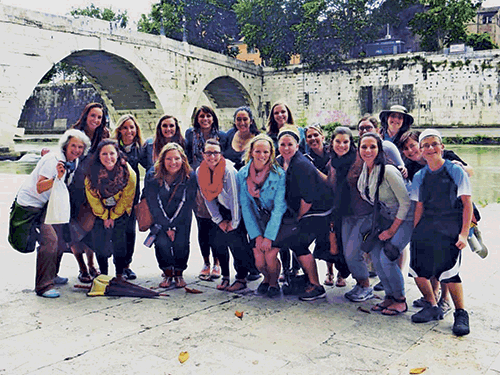
University of Minnesota student pharmacists in Rome.
During a 3-week Exploring Health through Art and Culture in Italy class at the University of Minnesota College of Pharmacy, student pharmacists explored the connections among health, art, and community. While dissecting Italy’s history—and viewing a lot of art—we discovered that leadership was intertwined throughout these areas. One of the central figures who displayed leadership was the well-known artist Michelangelo.
The artist’s influence
At first glance, it would seem that Michelangelo has nothing to do with pharmacy. In fact, however, art has a great influence over how the community views health care. Someone like Michelangelo becomes a timeless leader by creatively expressing the environment around him with a unique artistic twist. Michelangelo displayed two types of leadership: adaptive and technical. These types of leadership exemplify being able to survey the world around him and put his ideas into action.
Pharmacy in particular shares many traits with art, including passion for innovation, leadership, and a thirst for medical knowledge. To this day, Michelangelo is still one of the most astounding artists to display these themes. He was a leader who taught the world a lot about medicine through his art.
Pharmacy can learn from the teachings of Michelangelo. The profession can embrace change in the new medical world, just as Michelangelo took risks by approaching his works in a new and unique way. For instance, in 1501 the Florentine Republic asked Michelangelo to create a large statue of one of the Bible’s most famous stories, David and Goliath. Michelangelo’s version of David was unique. It did not share the same style as previous David sculptures had. The distinguishing features include David standing 17 feet tall and nude. David is thought to be preparing for battle with Goliath rather than holding Goliath’s head post-battle, as seen in previous statues. David’s eyes show his struggle and anticipation for battle, as well as his fear and determination. This sculpture is one example of the revolutionary work of Michelangelo.
How they roll in Italy
In addition to learning about how art connects to health, we also were able to explore pharmacy in Italy. We visited every pharmacy we could. One pharmacist, Pier Terigi in Siena, allowed us to explore the older part of the pharmacy where compounding occurred regularly. In Italy, all of the medications are behind the counter, and the patient must ask a pharmacist for them. This provides a counseling opportunity for each patient who enters the pharmacy.
We also had the opportunity to visit with two practicing pharmacists at their homes in Florence. Barbara Taddei and Guilio Pacenti were both very welcoming and willing to share their experiences. We also met and learned from pharmacists whose family members had been in the profession for generations.
One theme consistent with American pharmacy is that pharmacists are passionate about pharmacy. Like a
student pharmacist in the United States, whose goal is to become the best pharmacist possible, Italian pharmacists hold a similar spark of innovation about the future.
In Michelangelo’s footsteps
Michelangelo’s leadership style is an example for student pharmacists everywhere. It is important that student pharmacists stand up and speak on behalf of what the profession should be. It is up to today’s student pharmacists to shape the future, just as Michelangelo shaped the statue of David.
In fact, following in Michelangelo’s footsteps could revolutionize pharmacy just as Michelangelo revolutionized art. Draw from Michelangelo’s leadership: “The greater danger for most of us lies not in setting our aim too high and falling short; but in setting our aim too low, and achieving our mark.”
Lauren Kaldun is a second-year and Sarah Derr is a third-year PharmD candidate at the University of Minnesota College of Pharmacy. Special thanks to Ladona Tornabene, PhD; Lisa Volgelsang, PhD; Karen Bastianelli, PharmD; and Kerry Fierke, EdD.

Student Pharmacist Magazine, Vol. 10, Num. 4